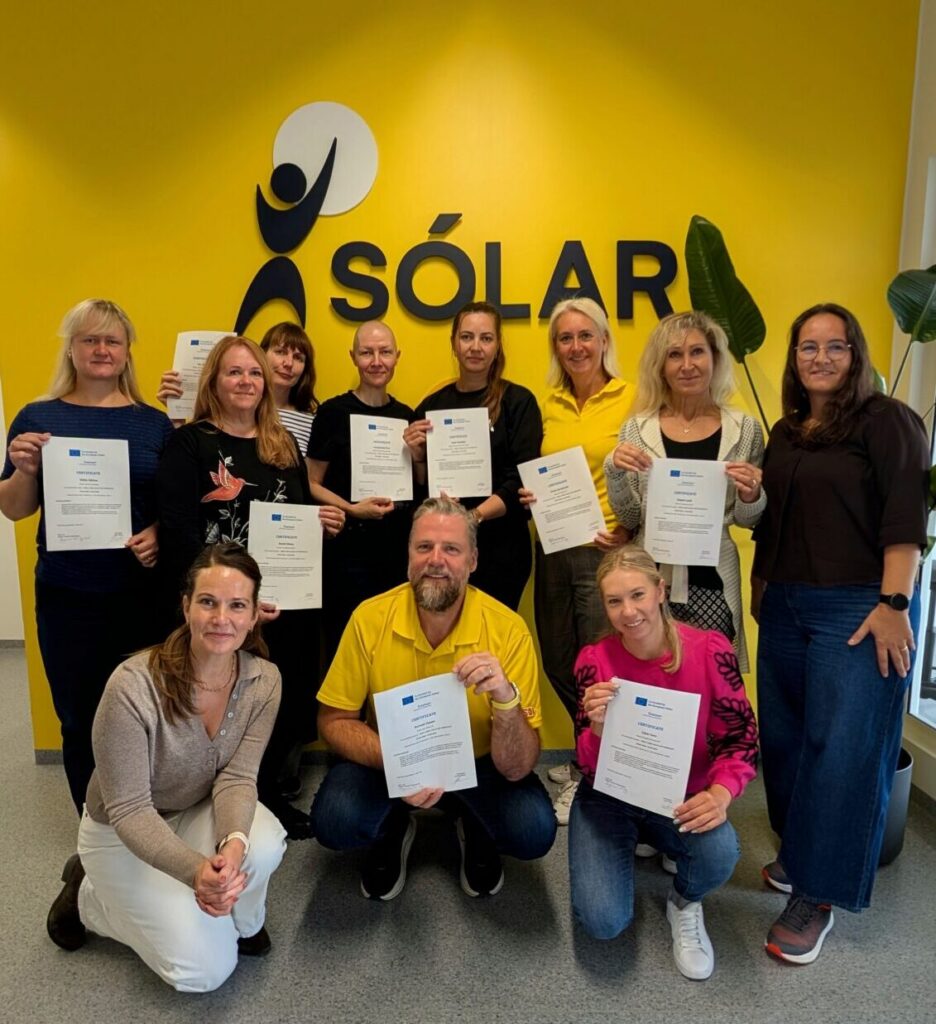
As part of the Erasmus+ programme, SOL Baltics participated in a job-shadowing mobility programme in Iceland from 4–14 August 2026. The mobility involved nine cleaning industry professionals from various organisations in Estonia, including cleaning companies, healthcare institutions and vocational education providers. The host organisation was Solar ehf, one of Iceland’s largest cleaning service companies. During the mobility, participants had the opportunity to learn about the company’s management practices, work organisation and the specific characteristics of the Icelandic cleaning services market.
Solar ehf serves approximately 900 clients and is one of the leading companies in Iceland’s cleaning services market. The company employs around 500 people. As part of the job-shadowing programme, participants visited hospitals, care homes, office buildings, shopping centres and a theatre, as well as the company’s office and laundry facility. Meetings with the company’s management also provided a comprehensive overview of the Icelandic cleaning services market and its challenges.
The Icelandic Labour Market Shapes Service Organisation
One of the key differences compared with the Baltic market is the impact of Iceland’s employment and social systems on the organisation of cleaning services.
Trade unions play a very strong role, and practically all formally employed people belong to a trade union. Collective agreements directly influence wages, working hours, benefits and working arrangements. At the same time, labour shortages present an ongoing challenge. The workforce consists mainly of employees from Poland. As the minimum wage and unemployment benefits are relatively close, recruiting employees is not always easy.
The system of sick leave is also noteworthy. Employees are entitled to a significant number of paid sick days, with the associated costs covered by the employer. At Solar, sick-pay costs account for as much as approximately 8% of turnover. This is one of the reasons why the company has developed a strong replacement team model, enabling it to maintain service continuity without relying extensively on overtime and the additional costs this creates.
The Replacement Team as a Strategic Tool
Solar has a replacement team of approximately 15 people whose main responsibility is to cover sick leave, holidays and vacant positions. When needed, the team also supports the launch of new sites and employee training.
For the mobility participants, it was particularly interesting to see that the replacement team is not viewed simply as a cost centre, but as an important tool for maintaining service quality and reducing overtime.
Digitalisation Supports Everyday Work
Solar’s operations are supported by a range of digital tools. The company uses its own information system to manage work schedules, working hours, customer communication, documents and orders.
Cleaning staff use a mobile application that provides access to work schedules, work instructions and working-time records. Employees can also use the app to order the necessary equipment and consumables.
Digital work instructions are prepared for each site, helping to ensure consistent service quality regardless of an employee’s level of experience or native language.
E-learning Helps Ensure Consistent Training
One of the most noteworthy aspects was Solar’s e-learning system. New employees complete a training programme consisting of short videos and knowledge tests covering topics such as the use of cleaning chemicals, equipment, waste management, reading work plans and other aspects of everyday work.
The training materials are visual, simple and available in multiple languages. This approach provides all employees with a consistent knowledge base and supports quality assurance in a rapidly changing work environment.
Environmental Topics Are Highly Visible
Environmental management was also an important part of the mobility. Positive examples included the widespread use of electric vehicles, waste sorting and a limited selection of cleaning products.
At the same time, the central laundry model and the company’s own central warehouse prompted lively discussions. These examples demonstrated well that sustainability-related decisions should always be considered from a broader perspective, taking into account environmental, quality and economic impacts.
What Can We Take Away from the Mobility?
The experience gained over the two weeks demonstrated how different market conditions shape the way companies organise their operations. Solar has developed solutions that respond to the specific characteristics of the Icelandic labour market, social system and geographical conditions.
Among the most valuable takeaways were the e-learning system, visual work instructions, digital solutions supporting both employees and clients, and the replacement team model.
The mobility confirmed that international exchange of experiences helps us look at our own field from a new perspective and identify ideas that can be adapted and applied in our own working environment.